Consumer Behavior and Customer Satisfaction Research
Business Research, Social and Political Research, Business Projects, Training and Consulting Services

Consumer Behavior and Customer Satisfaction Research
Used to understand customers, segment them, and measure their experience. Consumer and market behavior research focuses on understanding why, when, where, and how frequently people make purchases. This is one of the most fundamental parts of marketing strategy.
Main subtypes of consumer research:
- Consumer behavior research
- Stages of the purchase decision process and influencing factors
- Consumer psychology and consumption patterns
- Perceptions and impressions of a brand or organization
- Customer types, needs, and motivations in the market
- Buyer persona profiles and segmentation matrix
- Customer journey mapping
- Purchase and usage journey
- Customer satisfaction research (CSAT, NPS, CES)
- Service and product experience
- Service quality and level of trust
- Loyalty and repeat purchases
- Reasons for being a regular customer and level of satisfaction
The main indicators and content identified through this research can be categorized as follows.

Consumer Behavior Research
By identifying the values that your target customers care about, it becomes possible to successfully launch and sell a product in the market. Conducting consumer behavior research makes it possible to align product strategy with customer wants and interests. Consumer behavior research is also essential for classifying customers with similar interests, needs, and preferences, and ultimately positioning the product in the market according to those segments.
It examines individual psychology and the decision-making process.
- Purchase motivation: What most influences customers to make a purchase? (Price, quality, reputation, or the need to solve a problem.)
- Decision-making process: Where do customers get information about the product, and what criteria do they use to make their choice?
- Customer loyalty: The likelihood of repeat purchases and attitudes toward the brand.
- Current pain points and shortcomings: The difficulties and weaknesses customers face with the products or services they currently use.
What this research helps determine:
To determine how the product’s price influences customers’ purchasing decisions.
To define strategies such as customer segmentation, identifying target customers, and market allocation.
To understand that customer choice behavior is highly diverse and changes consistently over time, and to identify those patterns.
To determine the many roles customers assume during the purchase decision process, as well as the stages and steps involved in decision-making.
To determine whether the product meets customer expectations.
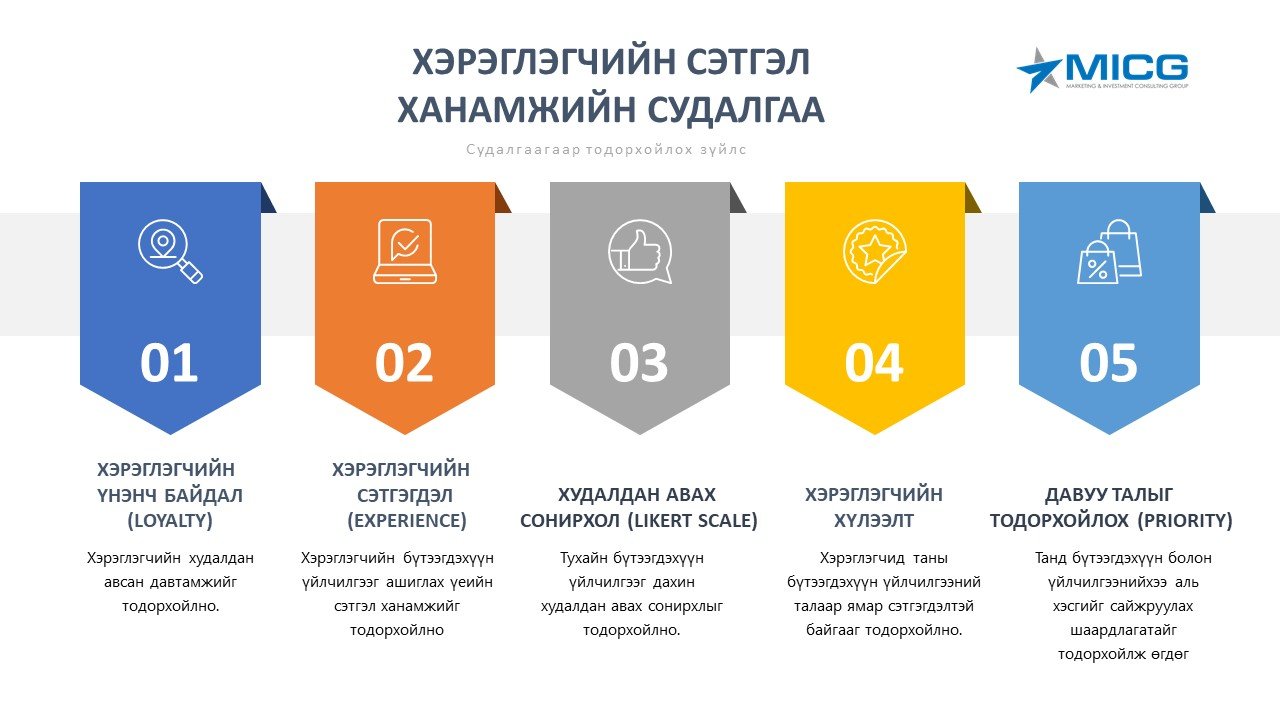
Customer Satisfaction Research
Customer satisfaction research is an important study that enables businesses to view the quality of their services and products through the eyes of customers and identify opportunities for improvement.
Customer satisfaction is determined by the value customers assign to a product based on their experience, including whether they would purchase it again, recommend it to others, and how consistently they continue to use that product.
Customer satisfaction is based on customer experience and loyalty.
To identify the above indicators, researchers structure the survey by grouping questions about customers’ experiences with the product as follows.
- Product quality
- Accessibility to customers
- Customer service
- Company reputation
- Price
The following indicators are identified through the research:
The research identifies the following indicators:
This measures how satisfied the customer is with the given product or service now, at that specific moment.
- Purpose: To know whether a specific action (such as making a purchase, receiving repair service, etc.) met the customer’s expectations.
- What it identifies: Impressions during that period such as product quality, staff interaction, service environment, and delivery speed.
- What it addresses: Used to promptly correct errors and shortcomings that occur during the service process and to evaluate employee performance.
This is the most common methodology that measures the likelihood of a customer recommending the given brand to others on a scale of 0–10.
- Purpose: To determine how loyal the customer is to the brand and the potential for future growth.
- What it identifies:
- Promoters (9, 10 points): People who make repeat purchases and promote it to others.
- Passives (7, 8 points): People who are satisfied but ready to switch to a competitor.
- Detractors (0–6 points): People who are dissatisfied and may negatively affect the brand’s reputation.
- What it addresses: The research results are used to define marketing strategy, resolve detractors’ complaints to prevent loss, and increase brand value.
This measures how much effort the customer made to receive service from the given company or to resolve their issue.
- Purpose: To evaluate how easy and understandable the process of receiving service is.
- What it identifies: It assesses whether the issue was resolved quickly through factors such as website usability, app clarity, and the operation of the customer support center.
- What it addresses: This research is used to reduce service steps, remove obstacles faced by customers, and automate operations.
By integrating the research results, the business makes the following strategic decisions:
- Preventing customer loss: Identifying dissatisfied customers early and retaining them by offering them special proposals.
- Product improvement: Finding out exactly what customers do not like (for example: slow delivery, or the app freezes) and making technological and operational changes.
- Employee incentives: Objectively evaluating the performance of customer-facing employees based on customer assessments.
- Sales growth: Used to activate and develop strategies for "Referral marketing" based on loyal customers (Promoters).